 Common Mistakes in SIL Calculation — Engineers Must Avoid
SIL calculation is not just numbers…
A small mistake can lead to under-design or over-design 
 Why it matters
 Wrong SIL =
 Unsafe system
Unnecessary cost
Compliance issues
 Common mistakes in SIL calculation
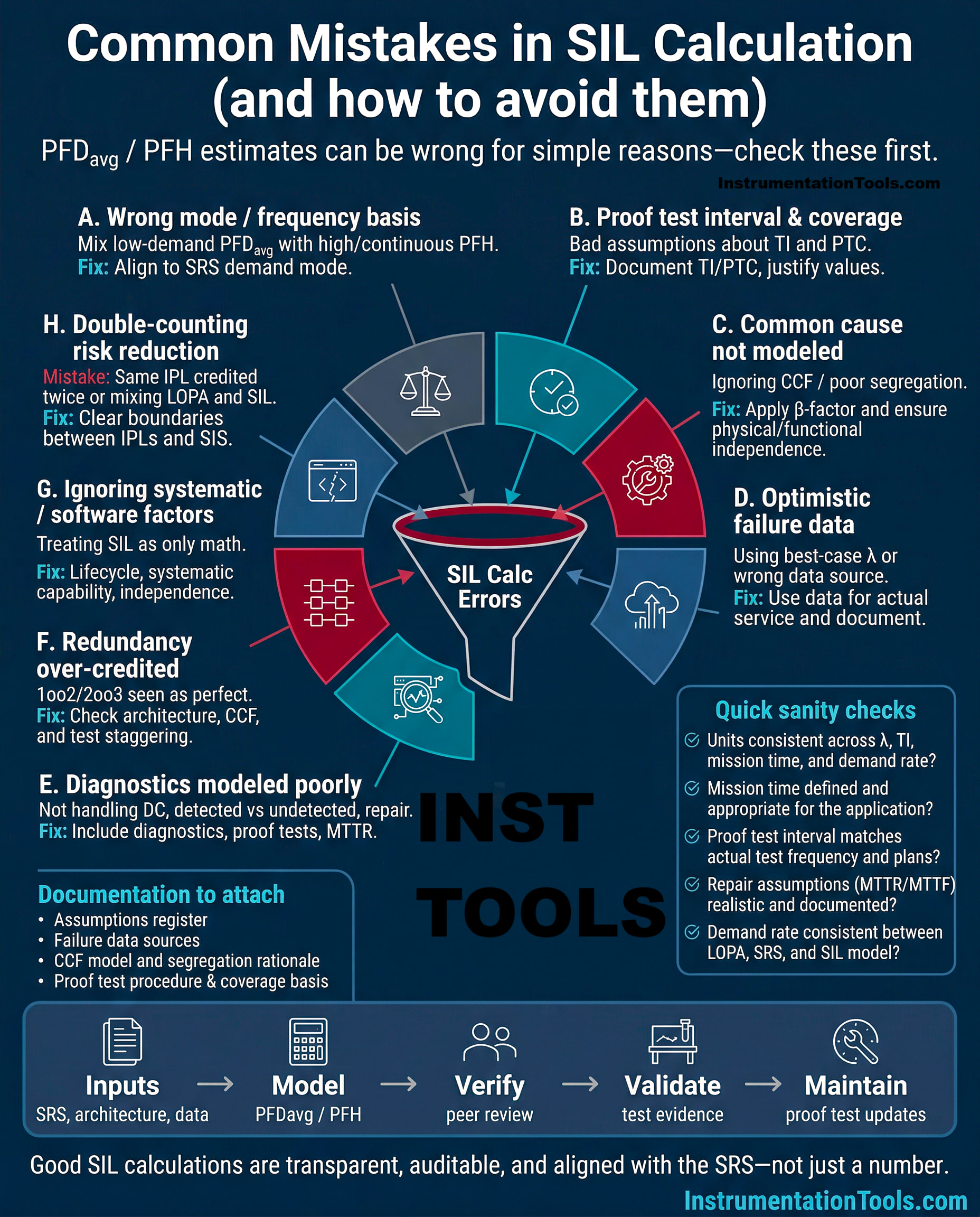
 Using wrong failure data
 Outdated or unrealistic failure rates
 Leads to incorrect PFD values
Ignoring common cause failures (CCF)
Assuming redundant devices are fully independent
Real systems often share environment, power, or design
Incorrect proof test interval
Using unrealistic testing frequency
Directly impacts SIL calculation
Overestimating diagnostic coverage
Assuming higher fault detection than actual
Gives false confidence in system reliability
Mixing SIL verification and validation
Confusing calculation with real testing
Both are required separately
Not considering real process conditions
Lab data ≠ Field conditions
Temperature, vibration, environment affect reliability
Assuming redundancy = higher SIL automatically
Wrong architecture or poor design reduces effectiveness
Design matters more than quantity
Ignoring human factors
Operator response assumed perfect
Human error must be considered
 Key takeaway
 Use accurate and validated data
 Consider real-world conditions
 Follow standards properly
 Validate with actual testing
 Simple understanding
SIL calculation is not just math…
It’s engineering + data + real conditions
Don’t just calculate SIL… engineer it correctly
WATCH VIDEO:
#FunctionalSafety #SIL #ProcessSafety #Instrumentation Automation #ControlSystems #Engineering #IEC61511 #SafetyEngineering #IndustrialSafety 