
 DERIVATIVE CONTROL: The Control Action That Reacts to the Rate of Change!
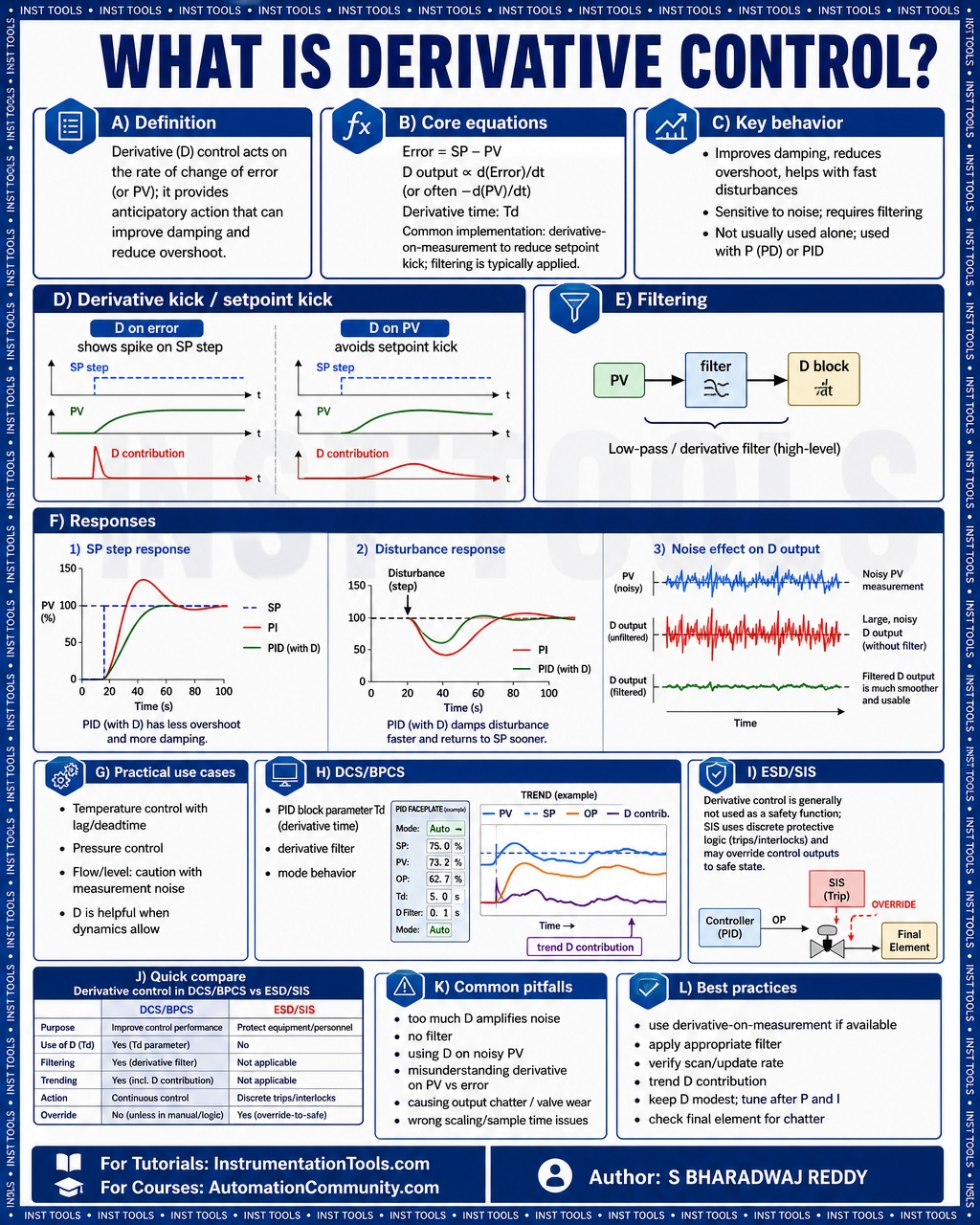
In a PID controller, Derivative (D) control looks at how quickly the error is changing, rather than only looking at how large the error is.
In simple words:
Proportional looks at the error.
Integral looks at accumulated error.
 What is Derivative Control?
Derivative control is a control action whose response is proportional to the rate of change of the error.
If the error is changing rapidly, the derivative action produces a larger corrective response.
Conceptually:
Error changing slowly → Small D action
Error changing rapidly → Large D action
Error not changing → No D action
 Example: Temperature Control
Suppose:
 Setpoint = 100°C
The process temperature is:
80 → 85 → 90 → 95°C
The temperature is moving rapidly toward the setpoint.
Even though the current error is still:
100 − 95 = 5°C
the derivative action recognizes:
“The temperature is rising rapidly.”
It can therefore reduce the controller output earlier to help prevent excessive overshoot.
What Does Derivative Control Do?
Derivative action can:
 Anticipate rapid changes
Improve damping
Reduce overshoot
Improve transient response
Help stabilize some processes
It is particularly useful when the process has significant inertia or tendency to overshoot.
 Major Disadvantage: Noise
Derivative action is highly sensitive to rapid changes in the measured signal.
Suppose a transmitter signal contains noise:
 PV:
PV:
50.0 → 50.3 → 49.8 → 50.2 → 49.7
The process may not actually be changing significantly, but the derivative term sees rapid changes.
This can produce:
Rapid controller output fluctuations
Valve movement
Unstable-looking control action
Therefore, derivative action is commonly implemented with filtering, and many industrial controllers apply derivative action to the PV rather than directly to the error to avoid derivative kick caused by sudden setpoint changes.
 P vs I vs D
| Control Action | Mainly Responds To | Main Purpose |
|---|---|---|
| P |
Present error | Immediate correction |
| I |
Accumulated error | Eliminate steady-state offset |
| D |
Rate of change | Anticipate/damp rapid changes |
 Easy Way to Remember
Imagine driving a car toward a wall:
P: “How far am I from the wall?”
I: “How long have I been too far from where I should be?”
D: “How quickly am I approaching the wall?”
So derivative action effectively says:
Interview Question
What is derivative control?
 Derivative control produces a corrective action based on the rate of change of the error. It can improve damping and reduce overshoot, but it is sensitive to measurement noise and therefore requires careful tuning and filtering.
#DerivativeControl #DerivativeAction #PID #PIDControl #ControlSystems #ProcessControl #Instrumentation dcs #PLC Automation #ControlEngineering #IndustrialAutomation #InstrumentationEngineer #ProcessControl