 If you work in process plants, you’ve heard “DCS” a thousand times. But a lot of juniors still quietly ask: what exactly is a Distributed Control System?
Distributed Control System
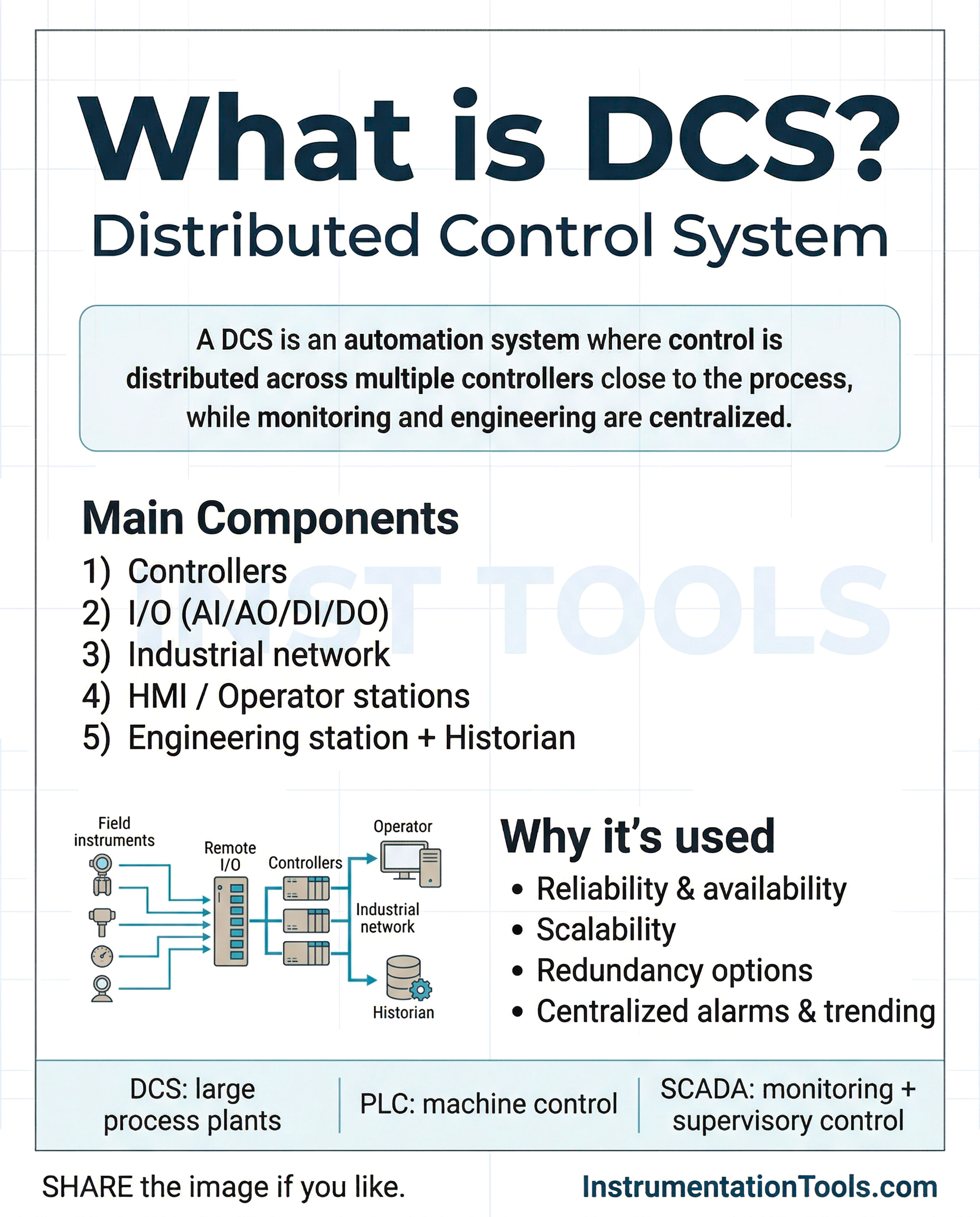
 Simple version:
A DCS is an automation system where control is distributed across multiple controllers in the field, while monitoring and engineering are centralized 
 You’ll see DCS used in continuous and batch process industries:
 Oil & gas
 Refining & petrochemical
 Power plants

 Pharma, pulp & paper, water/wastewater, etc.
 Typical building blocks:
 Controllers (perform the control logic)
 I/O modules (connect to field instruments and actuators)
 Networks (connect controllers, I/O, operator stations)
HMI / operator & engineering stations
 Historians (long-term storage, trends, reports)
 Why plants rely on DCS:
 High reliability and availability
 Easy to scale with plant expansion
 Built-in redundancy options
 Centralized monitoring and alarms
 Distributed control close to the process
 Very quick DCS vs PLC/SCADA (generalized):
DCS: deeper integration for large, continuous processes |  PLC/SCADA: flexible for machinery and discrete systems
DCS: rich built-in process control features |  PLC/SCADA: more open to custom architectures
DCS: unified engineering environment | PLC/SCADA: logic and SCADA often engineered separately
 More Information here: Learn about PLC, DCS, RTU, SCADA, and PAC - Inst Tools
 Share the image if you like
dcs #DistributedControlSystem #Instrumentation #IndustrialAutomation #ProcessControl #ControlSystems #SCADA #PLC #ProcessAutomation #IndustrialEngineering #ChemicalEngineering #ElectricalEngineering