
 ENERGIZE-TO-TRIP (ETT): When the Safety System Sends Power to Cause a Trip!
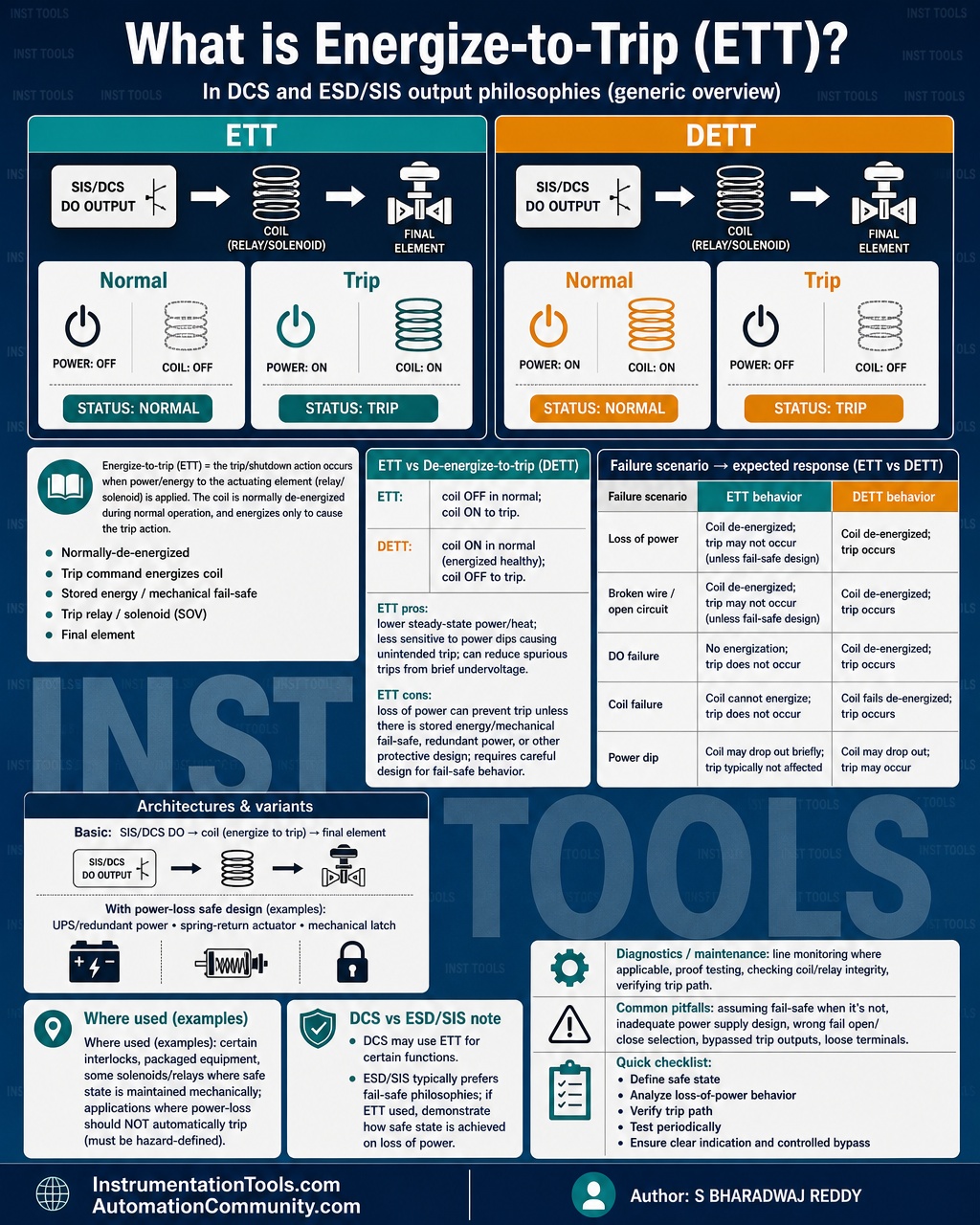
In an Energize-to-Trip (ETT) philosophy, the safety action is initiated by energizing the trip circuit.
In simple terms:
 How Does ETT Work?
Consider a shutdown solenoid valve:
ESD Logic → Output → Solenoid → Shutdown Valve
Under normal operation:
 Solenoid de-energized

Process equipment operates
When a trip condition occurs:
Trip detected
ESD output energizes
 Solenoid energizes
 Shutdown valve moves to its trip position
Process moves toward the safe state
 Simple Example
Suppose a compressor must trip when:
High-High Discharge Pressure
occurs.
Normal condition:
HH Pressure = FALSE
ETT output = OFF
Trip condition:
HH Pressure = TRUE
ETT output = ON
Trip circuit energizes
 Compressor trips
 The Major Disadvantage of ETT
Consider a failure in the trip circuit:
Broken wire
 No current can reach the trip device
But the system may interpret this as:
No trip
So certain faults can remain undetected unless additional diagnostics are provided.
This is one reason De-Energize-to-Trip (DTT) is widely used for many process shutdown applications.
 ETT vs DTT
| Energize-to-Trip |
De-Energize-to-Trip |
|---|---|
| Energy is applied to initiate trip | Energy is removed to initiate trip |
| Normal state generally energized/de-energized depending on design | Typically trip circuit energized during healthy operation |
| Trip requires energization | Trip occurs when circuit de-energizes |
| Loss of power may not automatically cause trip | Loss of power can initiate trip |
| Some circuit faults may not be inherently fail-safe | Can provide a fail-safe response to loss of energy |
 Simple Memory Trick
ETT
Energize = Trip
DTT
De-energize = Trip
Important Functional-Safety Point
ETT is not automatically unsafe, and DTT is not automatically safe.
The correct trip philosophy depends on:
Hazard analysis
Safe-state requirements
Final-element design
Failure modes
Diagnostic coverage
Spurious-trip requirements
Process operating conditions
SIS architecture
Applicable functional-safety requirements
For example, some applications may intentionally use energize-to-trip where the process and safety analysis justify it.
 Interview Question
What is Energize-to-Trip (ETT)?
 Energize-to-Trip is a trip philosophy in which the safety system initiates the specified shutdown action by energizing the trip circuit or final element.
 Remember:
The key question in safety design is not simply “ETT or DTT?”—it is whether the selected philosophy provides the required safety integrity and appropriate response to credible failures.
#EnergizeToTrip #ETT #DeEnergizeToTrip #DTT #ESD #SIS #FunctionalSafety #IEC61511 #SafetyPLC #ProcessSafety #Instrumentation #IndustrialAutomation #SafetyInstrumentedSystem #OilAndGas #InstrumentationEngineer