
 ESD SYSTEM – INHIBIT SIGNALS: When a Trip Condition Is Temporarily Prevented!

In an ESD (Emergency Shutdown) system, an inhibit signal is used to prevent a specified input, condition, or logic action from producing its normal shutdown response under defined circumstances.
An inhibit does not make the hazardous condition disappear—it only changes how the ESD logic responds to it.
 Simple Example
Consider:
High-High Pressure → ESD Logic → Shutdown Valve
Normally:
HH Pressure detected

 ESD logic
Shutdown valve closes
If an approved inhibit is active:
HH Pressure detected
Inhibit active
 Specified ESD action is prevented
The exact behavior depends on the configured ESD logic.
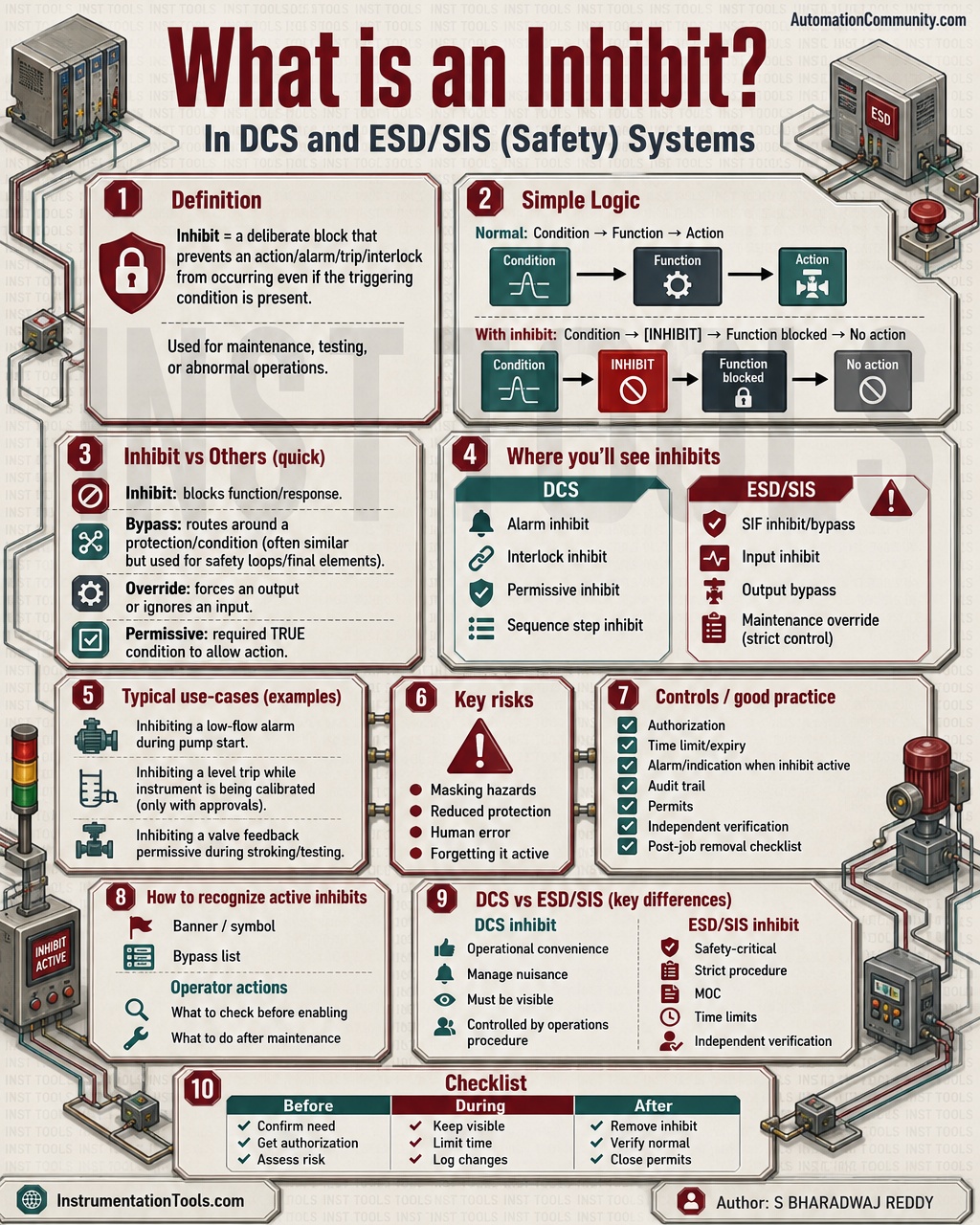
Why Are Inhibit Signals Used?
Inhibits may be required during specific operating conditions such as:
 Maintenance
 Testing
 Startup
 Shutdown
Equipment unavailable
 Commissioning
Defined process operating states
For example, a shutdown signal may be intentionally inhibited during startup if the process condition being monitored is expected during startup and would otherwise cause an unwanted trip.
Startup Example
Suppose a process normally generates a low-flow condition during startup.
If the low-flow trip were active immediately:
Start process
 Flow temporarily low
Low-flow trip
Process shuts down
The approved startup philosophy may therefore allow that particular trip to be inhibited during a defined startup phase.
Once normal operating conditions are established:
 Inhibit removed
 The protection becomes active again.
Why Are Inhibits Dangerous?
When an inhibit is active:
A safety function may not respond normally
Protection may be temporarily reduced
A genuine hazardous condition could go without the expected shutdown
For example:
Genuine high pressure
 Trip input generated
Inhibit still active
Expected shutdown does not occur
This is why inhibit management is critical.
 Good Inhibit Practices
An ESD inhibit should be:
 Authorized
Risk assessed
 Clearly indicated
 Known to operations
 Recorded
 Controlled for duration
 Removed when no longer required
 Verified after restoration
Where appropriate, the system may use automatic inhibit removal based on operating state or defined conditions.
 Inhibit vs Bypass vs Force
These terms are not universally identical across all ESD/SIS platforms.
Inhibit
→ Prevents a specified signal/condition/action from participating in the defined logic.
Bypass
→ Temporarily prevents a specified safety function from performing its normal action.
Force
→ Overrides a selected signal/state with a defined value.
 Always verify the ESD vendor logic, Cause & Effect, and plant philosophy to determine exactly what an inhibit does.
 Interview Question
What is an inhibit signal in an ESD system?
An inhibit signal is a controlled signal used to prevent a specified ESD input, condition, or logic action from producing its normal shutdown response under defined operating or maintenance conditions.
 Remember:
And the most important rule:
Apply only when justified → control the risk → clearly indicate it → remove it when no longer required → verify the protection is restored.
#ESD #InhibitSignal #ESDSystem #SIS #SafetyInstrumentedSystem #FunctionalSafety #ProcessSafety #IEC61511 #SafetyPLC #Instrumentation dcs #IndustrialAutomation #ControlSystems #OilAndGas #InstrumentationEngineer