 Field Wiring Practices for SIS — Small Mistakes Can Defeat Safety
In a Safety Instrumented System (SIS), even perfect logic cannot protect the plant if the field wiring is wrong 
 Why SIS wiring is critical
 SIS depends on reliable signal transmission
Wiring faults can cause:
 False trips
Hidden failures
Loss of protection
 Best wiring practices for SIS
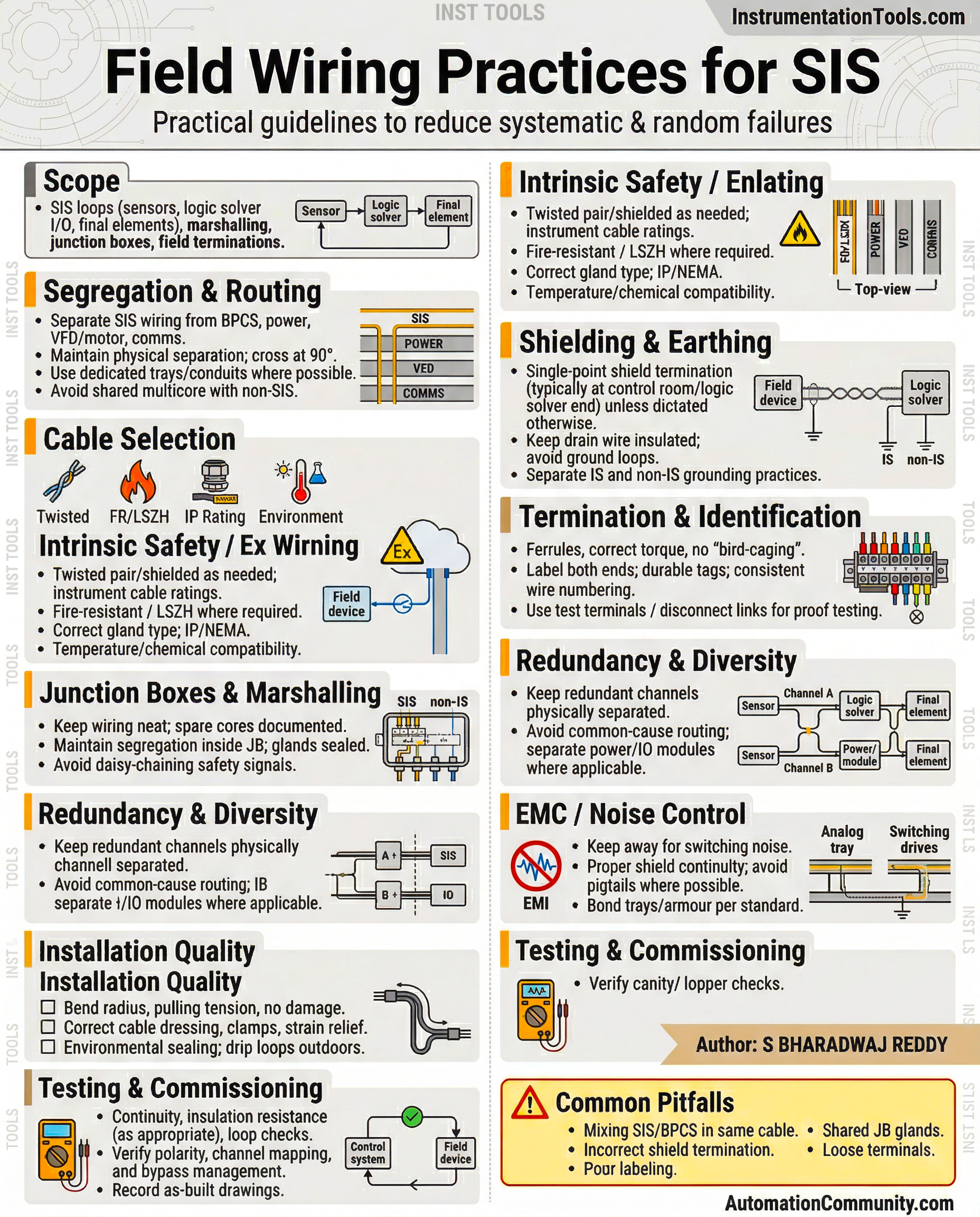
 Use dedicated wiring
Keep SIS wiring separate from BPCS/control wiring
 Avoid common failure paths
Proper cable shielding & grounding
Shield analog/safety signals properly
Ground shield at one side only (as per design)
 Reduces electrical noise & interference
Avoid shared terminals
Do not mix SIS and non-SIS signals in same terminal loops
 Maintains independence
Use redundant cable routing
Separate paths for redundant channels (1oo2 / 2oo3)
Prevents single physical damage affecting all channels
Proper cable identification
Clear tagging and ferruling
Separate SIS marshalling panels
Easier maintenance & troubleshooting
Follow fail-safe philosophy
Design outputs as:
 De-energize to trip
Detect open circuit conditions
 Common SIS field devices
 Pressure transmitters
Temperature transmitters
Solenoid valves
ESD valves
Flame detectors
Common mistakes
 Shared power supplies
Poor grounding
Mixing SIS & control cables
No segregation between redundant channels
 Key takeaway
 SIS wiring must be independent
 Noise & common failures must be minimized
 Good wiring = Reliable safety protection
 Simple understanding
In SIS, wiring is not just installation… it’s part of the safety design.
#SIS #ProcessSafety #FunctionalSafety #Instrumentation Automation #ControlSystems #Engineering #IndustrialAutomation #IEC61511 #SafetyPLC 