Imagine a process plant where a dangerous condition develops:
 Pressure rises rapidly
 Temperature exceeds a safe limit
 Toxic gas is detected
 Rotating equipment becomes unsafe
What happens if the normal control system cannot bring the process back to a safe condition?
 Functional Safety provides a structured way of using safety-related systems to reduce risk by performing specified safety functions when required.
 What is Functional Safety?
Functional Safety is the part of overall safety that depends on a system or equipment correctly performing safety functions in response to specified conditions.
In simple terms:
Dangerous condition → Safety function operates → Process moves toward a safe state
Functional safety is especially important in systems such as:
 SIS
SIS
ESD systems
Fire & Gas systems
Safety PLCs
 Machine safety systems
 Process safety systems
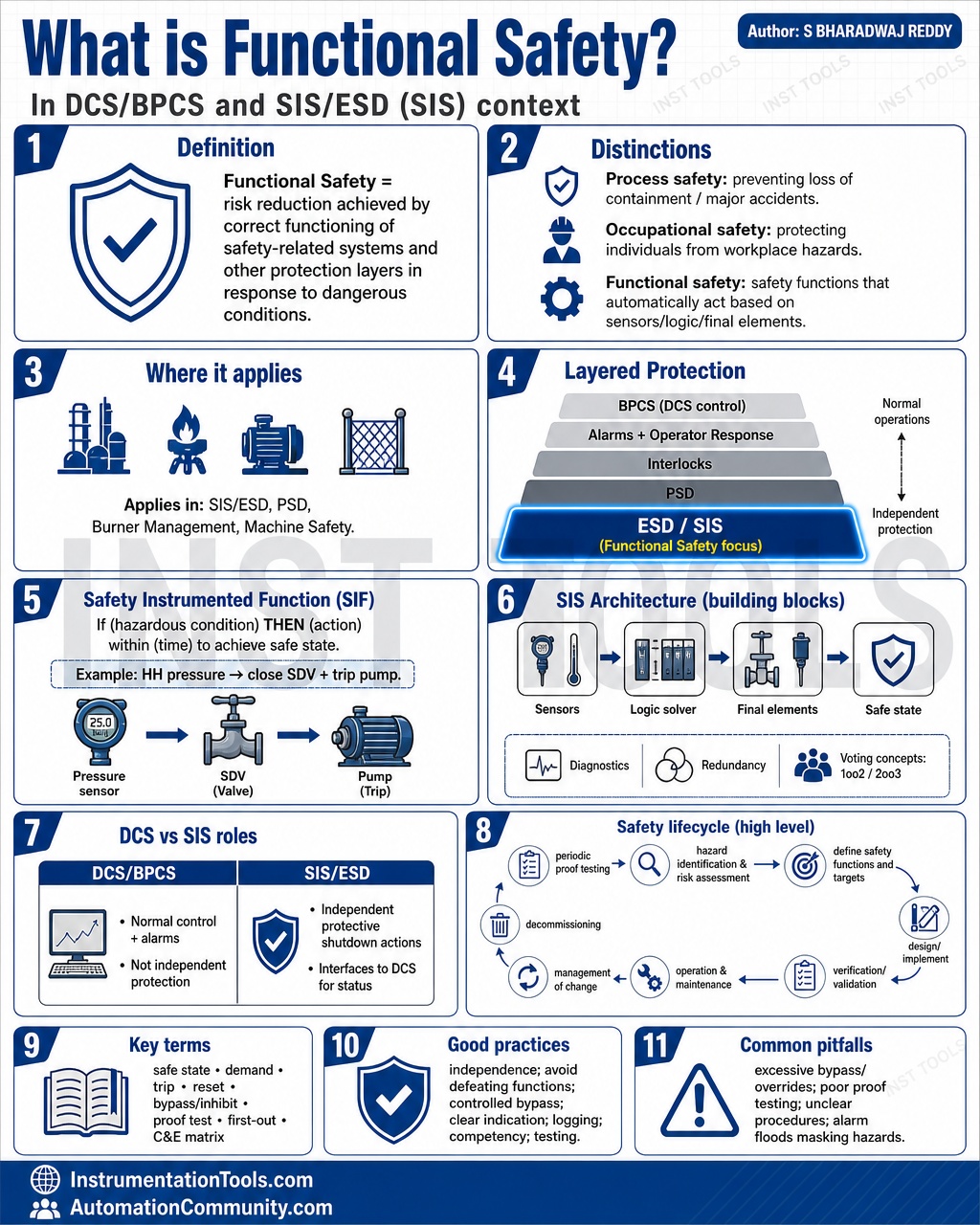
Simple SIS Example
Consider a high-pressure reactor.
Normal control:
Pressure Transmitter → DCS → Control Valve
But suppose the pressure continues increasing despite normal control action.
A safety function may be:
High-High Pressure → SIS → Close Shutdown Valve
When the specified trip condition occurs:
High-high pressure detected

 Safety logic solver evaluates the condition
 Shutdown valve closes
Process moves toward a defined safe state
That complete protective action is a Safety Instrumented Function (SIF).
 Functional Safety Is NOT Just “Safety”
A common misunderstanding is:
 Functional Safety = General plant safety
Instead:
Overall Safety includes many areas:
 Procedures
 Training
 Mechanical design
Fire protection
Functional safety
Emergency response
Functional safety specifically addresses risk reduction achieved through safety-related functions and systems.
 What is SIL?
Safety Integrity Level (SIL) is used to specify the required level of risk reduction for certain safety functions.
There are four SIL levels:
SIL 1 → SIL 2 → SIL 3 → SIL 4
For process-industry SIS applications, SIL 1, SIL 2, and SIL 3 are commonly relevant; SIL 4 is generally associated with extremely high-integrity applications and is not normally used for process-industry SIS.
Higher SIL generally means a greater required level of risk reduction and integrity, subject to the applicable standard and architecture.
 Functional Safety Lifecycle
Functional safety is not simply:
Design SIS → Install SIS → Done
It involves a lifecycle including:
 Hazard & risk analysis
 Risk reduction requirements
SIL determination
 Safety Requirements Specification
SIS design
 Installation & commissioning
 Validation
 Operation & maintenance
Proof testing
 Management of Change
 Decommissioning
 Functional Safety vs Process Control
BPCS / DCS:
Primarily controls the process during normal operation.
SIS:
Performs specified safety functions when dangerous conditions occur.
For example:
 DCS: Maintain pressure at 50 bar.
SIS: If pressure reaches the defined dangerous condition, isolate the process to prevent the hazardous event.
 The Most Important Concept
Functional safety is based on a simple principle:
A safety system must perform its specified safety function when demanded—and its performance must be maintained throughout its lifecycle.
That means simply installing a Safety PLC does not automatically make a system functionally safe.
You need:
 Correct safety requirements
Appropriate architecture
Suitable devices
Validated logic
Defined proof testing
Competent maintenance
Controlled bypasses
Proper MOC
Lifecycle management
Interview Question
What is Functional Safety?
Functional safety is the part of overall safety that depends on safety-related systems correctly performing specified safety functions in response to defined hazardous conditions, thereby reducing risk to an acceptable level.
Functional Safety = Safety Function + Correct Performance + Lifecycle Management
#FunctionalSafety #SIS #SafetyInstrumentedSystem #SIL #IEC61511 #IEC61508 #ESD #ProcessSafety #SafetyPLC #Instrumentation #IndustrialAutomation #ProcessControl #OilAndGas #SafetyEngineering #InstrumentationEngineer