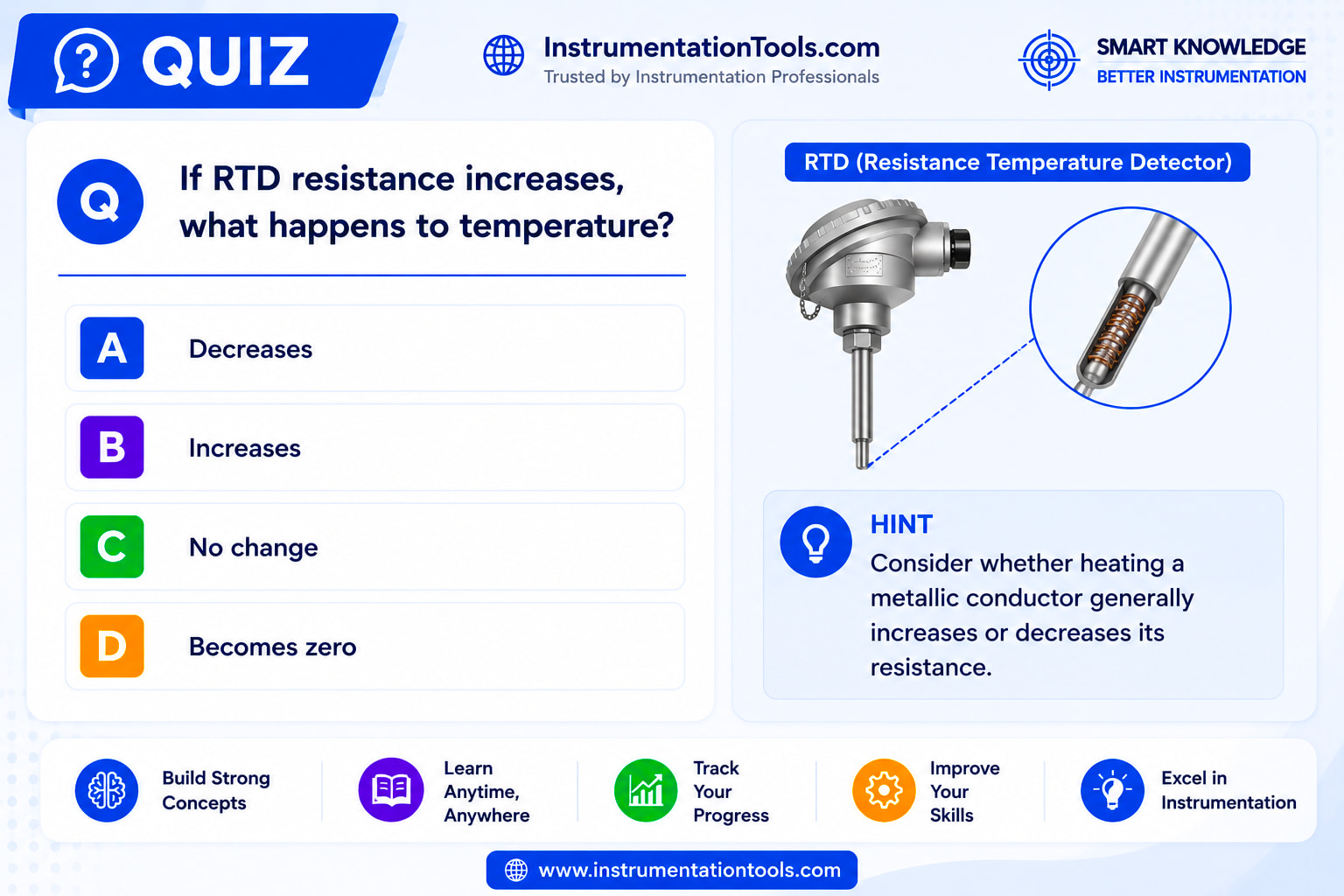
If RTD resistance increases, what happens to temperature?
A. Decreases
B. Increases
C. No change
D. Becomes zero
View Answer
Correct Answer: B
Explanation:
An RTD (Resistance Temperature Detector) operates on the principle that the electrical resistance of the sensing element increases as temperature increases.
For a Pt100 RTD, the relationship can be approximated by:
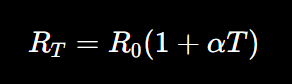
Where:
- RT = Resistance at temperature T
- R₀ = Resistance at 0°C
- α = Temperature coefficient
- T = Temperature
From this formula, as the temperature (T) increases, the resistance (RT) also increases.
For example:
- 0°C → 100 Ω
- 50°C → 119.4 Ω
- 100°C → 138.5 Ω
- 200°C → 175.9 Ω
Since RTD resistance rises with temperature, an increase in resistance indicates that the temperature has increased.
Therefore, Option B (Increases) is the correct answer.