
 INHIBIT vs BYPASS: Are They Really the Same in SIS/ESD?
These two terms are often used interchangeably in plants, but they can have different meanings depending on the SIS/ESD vendor and project philosophy.
Understanding the distinction is important during commissioning, maintenance, and operation.
 INHIBIT
An inhibit generally means that a particular condition, signal, or action is prevented from participating in a defined logic function.
For example:
High Pressure Signal → ESD Logic → Trip
If the high-pressure input is inhibited:
High Pressure

 Input Inhibited
 It does not produce the intended trip through that logic path.
An inhibit may be applied for a specific operating state or maintenance activity, depending on the design.
BYPASS
A bypass generally means that a specified safety function or part of the safety logic is temporarily prevented from producing its normal action, while the process continues operating.
Example:
Pressure Transmitter → SIS → Shutdown Valve
During approved maintenance:
 Maintenance required
 Safety function temporarily bypassed
 Maintenance performed
 Bypass removed
Safety function restored
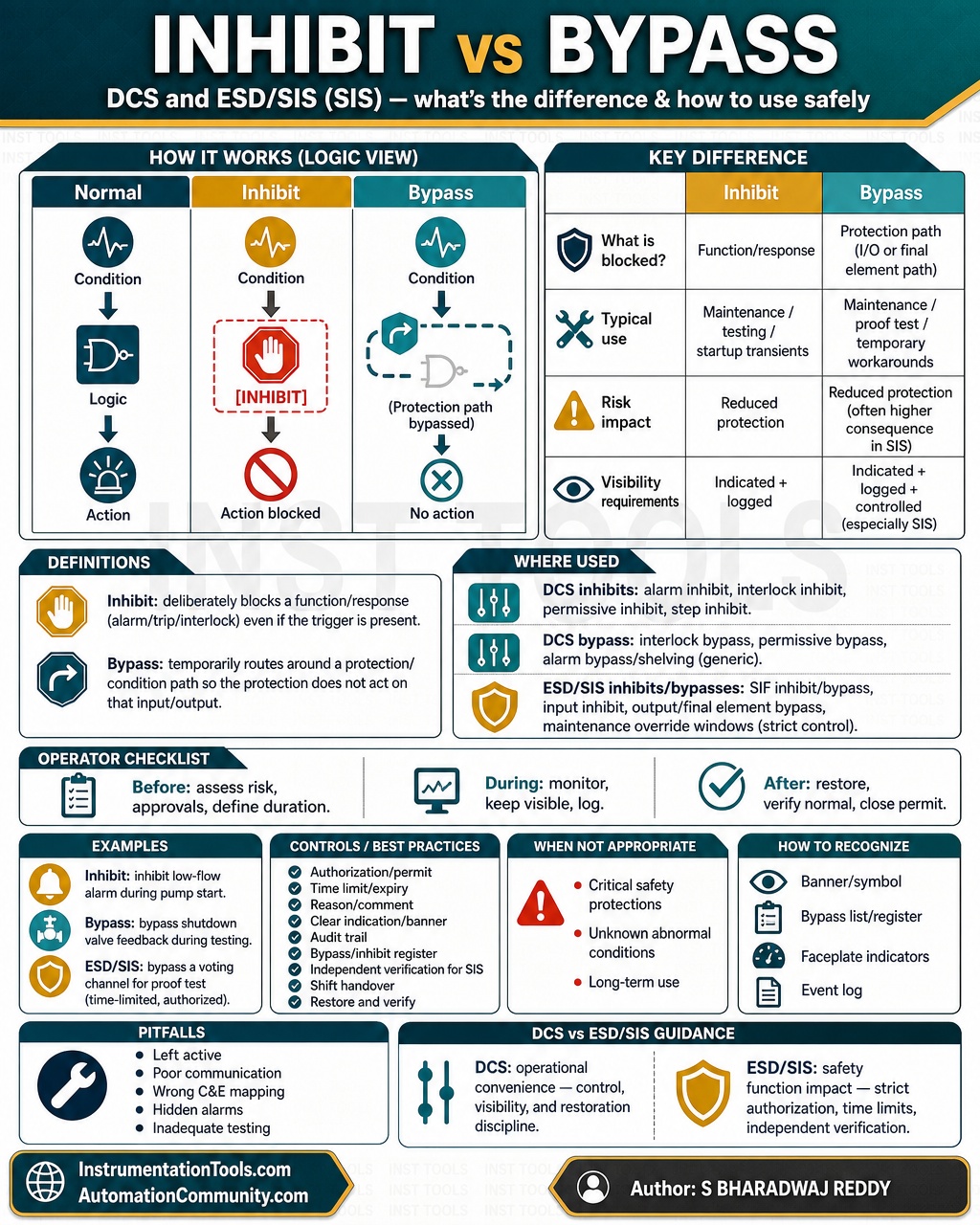
 Inhibit vs Bypass
| Inhibit |
Bypass  |
|---|---|
| Prevents a signal/condition from participating in logic | Temporarily prevents a specified function/action |
| Often applied to an input or logic condition | May apply to a safety function or logic path |
| Can be part of operating-state logic | Often associated with maintenance/testing |
| Scope depends on system design | Scope depends on system design |
| May be automatically or manually applied | Commonly controlled and authorized |
VERY IMPORTANT
There is no universal IEC definition that makes “inhibit” and “bypass” identical or universally different.
Different SIS/ESD manufacturers and project specifications may define these terms differently.
For example, one system may use:
INHIBIT = prevent a trip under a defined process condition
while another may use:
BYPASS = temporarily remove a function from service for maintenance.
Therefore, always check:
 SIS Philosophy
Cause & Effect
Logic Diagrams
Vendor Documentation
Operating Procedures
before interpreting the function.
Why Is This Critical?
Both can potentially reduce the protection provided by an SIS/ESD function.
If a safety function is inhibited or bypassed:
Protection may be unavailable
Risk may increase
Operator awareness is required
Authorization may be required
Compensating measures may be necessary
The function must be restored when the activity is complete
 Easy Way to Remember
INHIBIT → “Don’t let this condition participate in this action.”
BYPASS → “Temporarily go around this function.”
But in a real plant:
Don’t rely on the word alone. Check exactly what the SIS logic does when the inhibit or bypass is activated.
#Inhibit #Bypass #SIS #ESD #SafetyInstrumentedSystem #FunctionalSafety #SIL #IEC61511 #ProcessSafety #SafetyPLC #Instrumentation dcs #IndustrialAutomation #ControlSystems #OilAndGas #InstrumentationEngineer 