 Risk Graph vs LOPA — SIL Determination Made Simple
When deciding SIL levels, engineers often ask:
 Risk Graph or LOPA… which one to use?
Here’s a clear comparison 
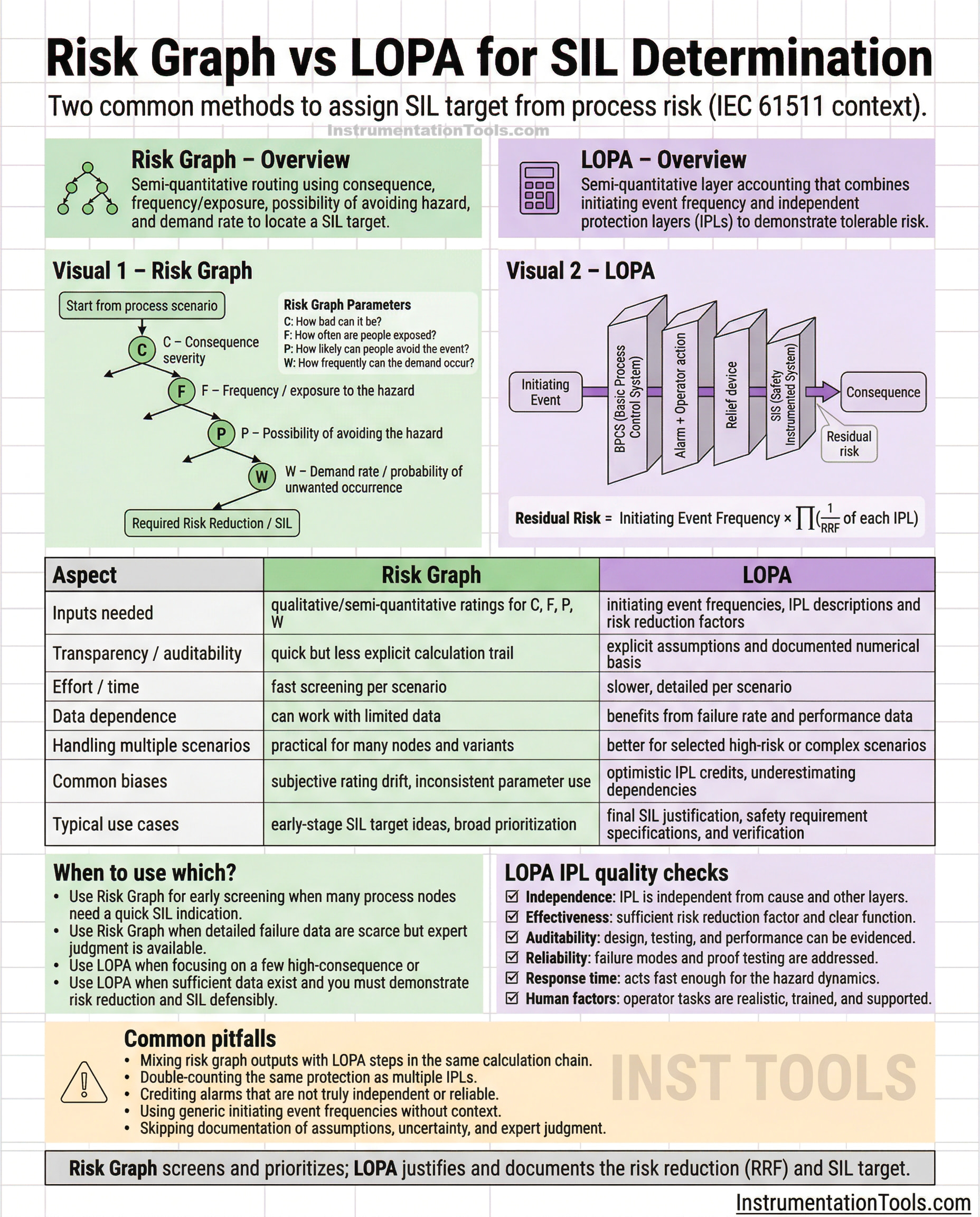
 Risk Graph Method
 Qualitative approach
Uses parameters like:
 Severity (S)
Frequency (F)
Probability (P)
Avoidance (A)
Based on answers, SIL is selected from a graph/chart
 Why Risk Graph is used
 Quick and simple
Less data required
Useful in early project stages
 Depends heavily on engineering judgment
LOPA (Layers of Protection Analysis)
Semi-quantitative method
Uses numerical values for:
Event frequency
Protection layer effectiveness
Risk reduction
Calculates required SIL more accurately
Why LOPA is used
More detailed and reliable
Based on actual data
Widely used in real projects
 Key Differences
Risk Graph → Qualitative
LOPA → Semi-quantitative
Risk Graph → Faster
LOPA → More accurate
Risk Graph → Early design stage
LOPA → Detailed design stage
 Practical approach
Risk Graph → Initial SIL estimation
LOPA → Final SIL confirmation
 Key takeaway
 Use Risk Graph for quick screening
 Use LOPA for final decision
 Both aim to reduce risk to acceptable level
 Simple understanding
Risk Graph = Quick judgment
LOPA = Calculated decision
WATCH VIDEO:

#FunctionalSafety #SIL #LOPA #ProcessSafety #Instrumentation Automation #ControlSystems #Engineering #IEC61511 #SafetyEngineering