 Safety Lifecycle as per IEC 61511 — Explained Simply
Functional safety is not just design…
It’s a complete lifecycle from concept to operation 
 What is Safety Lifecycle?
 A structured approach defined in IEC 61511
Covers design, implementation, operation, and maintenance
Ensures safety is maintained throughout the plant life
 Why it matters
 Safety is not one-time… it must be managed continuously
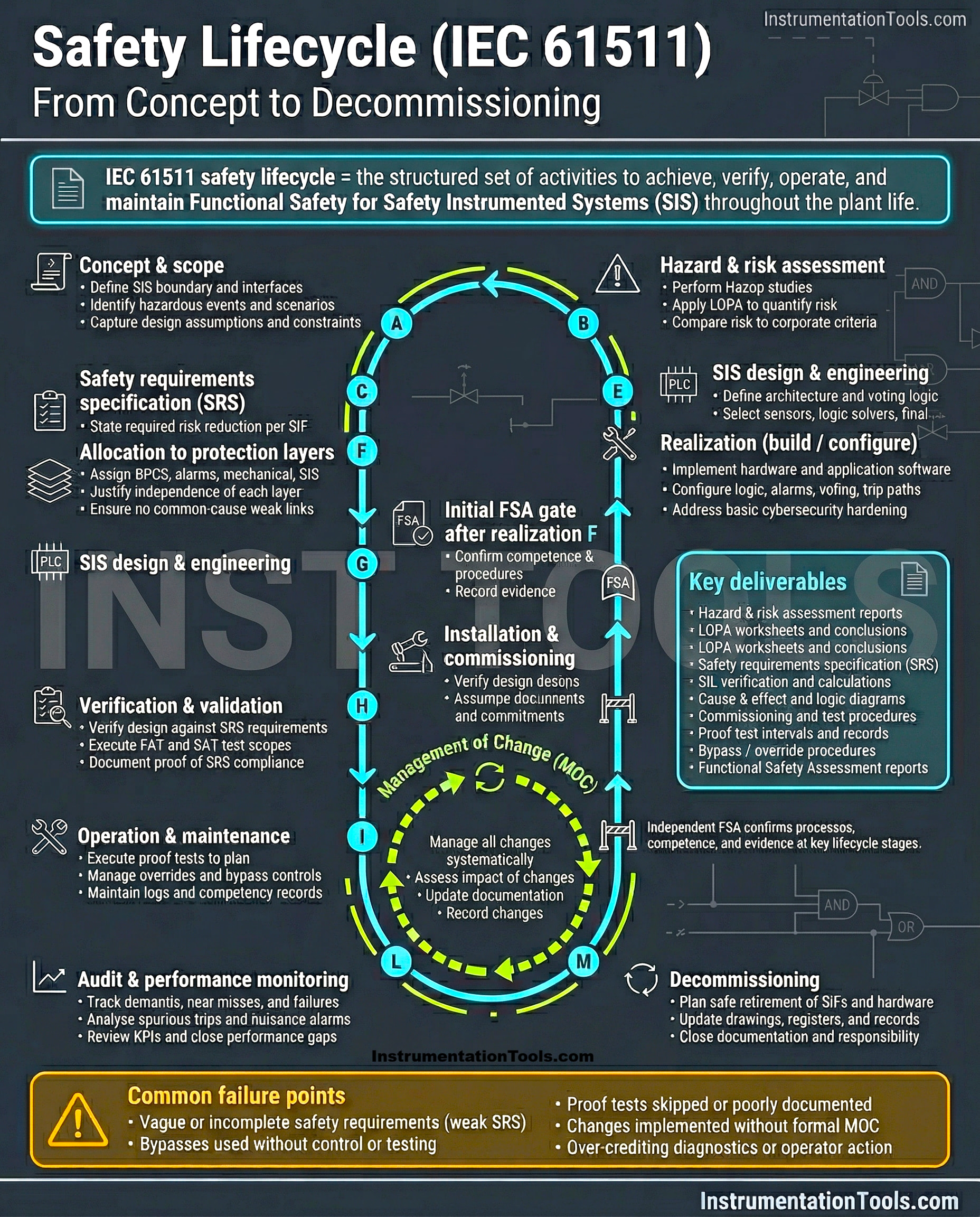
 Main Stages of Safety Lifecycle
 1. Hazard & Risk Analysis
Identify hazards using HAZOP / risk studies
Define required risk reduction
 2. LOPA & SIL Determination
Evaluate protection layers
Assign required SIL level
 3. Safety Requirements Specification (SRS)
Define what the safety system must do
Includes logic, response time, trip conditions
 4. Design & Engineering
Design SIS architecture
Select sensors, logic solver, final elements
 5. Installation & Commissioning
Install hardware
Perform loop checks & integration
 6. Validation
Test if system works as per SRS
Confirm safety functions (SIFs)
 7. Operation & Maintenance
Routine testing
Proof testing of safety loops
Fault handling
 8. Modification & Decommissioning
Manage changes safely
Proper shutdown at end of lifecycle
WATCH VIDEO:
 Key idea
Safety is not just design… it’s a continuous process
 Important
 Skipping steps = Unsafe system
 Following lifecycle = Reliable safety
 Simple understanding
Design → Test → Operate → Maintain → Improve
#FunctionalSafety #IEC61511 #SIS #ProcessSafety #Instrumentation Automation #ControlSystems #Engineering #IndustrialSafety #SafetyEngineering 