Question:
What happens if derivative action is applied to a noisy signal?
Options:
A) Noise amplifies
B) Stable Output
C) Noise eliminated
D) Reduces Offset
View Answer
 Correct Answer: A) Noise amplifies
 Detailed Explanation
Derivative action responds to the rate of change of error:
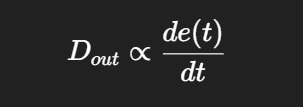
Noise contains rapid, high-frequency fluctuations. Since derivative reacts strongly to rapid changes, it amplifies noise, causing:
- Erratic controller output
- Unstable actuator movement
- Excessive valve wear
This is why derivative filtering is commonly used in industrial PID controllers.
 Practical Insight
If you observe:
- Output jitter
- Fast oscillations
- Valve chattering
Check the derivative setting or apply filtering.
 Why Other Options Are Incorrect
B) Stable Output → Derivative on noisy signals reduces stability.
C) Noise eliminated → Derivative increases sensitivity to noise, it does not remove it.
D) Reduces Offset → Offset is removed by integral action, not derivative.