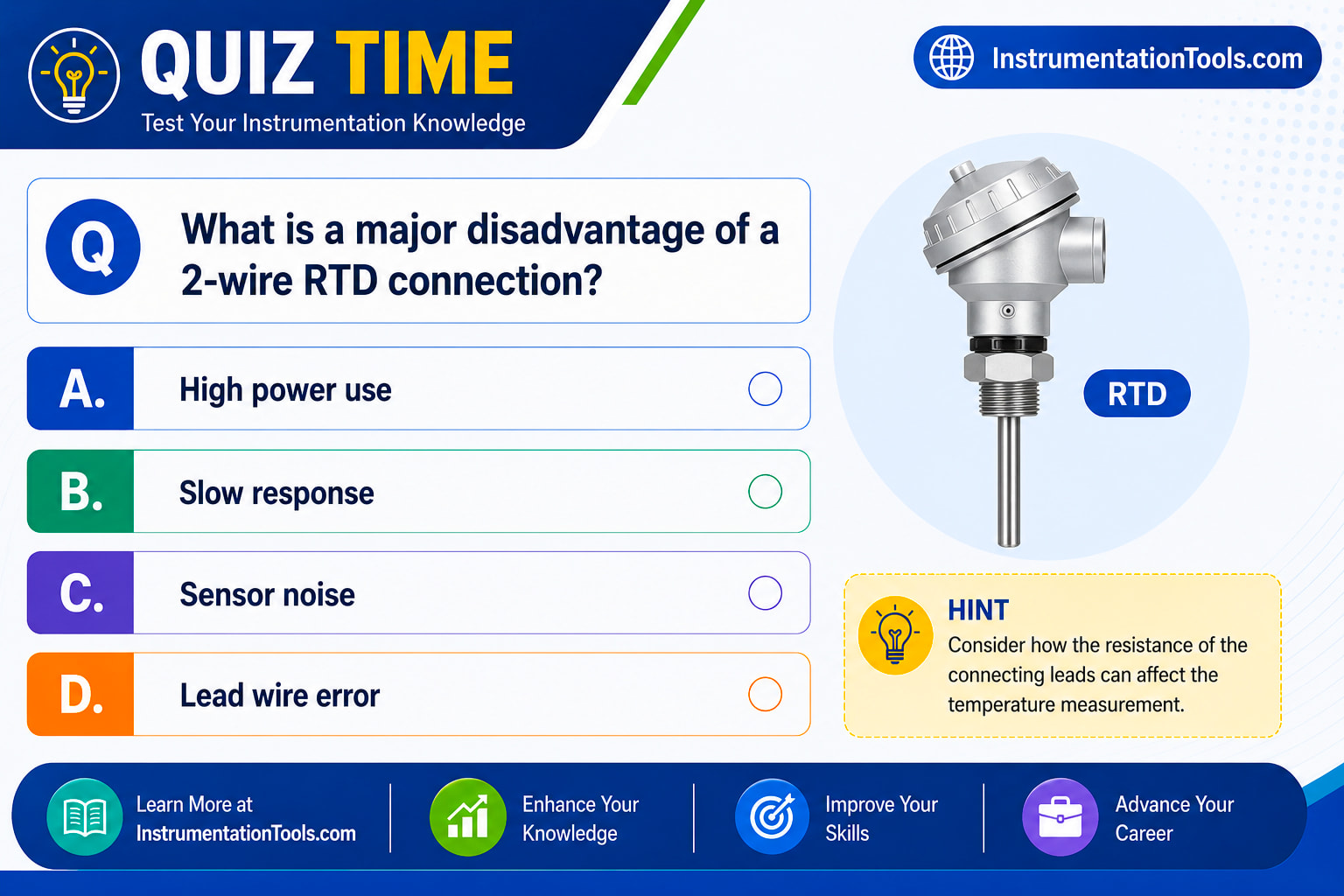
What is a major disadvantage of a 2-wire RTD connection?
A. High power use
B. Slow response
C. Sensor noise
D. Lead wire error
View Answer
Answer: D
Explanation:
The biggest disadvantage of a 2-wire RTD connection is that the resistance of the lead wires is added directly to the RTD resistance, causing measurement errors.
The measuring instrument cannot distinguish between:
- RTD resistance
- Cable (lead wire) resistance
As a result, the displayed temperature is higher than the actual temperature.
For example:
- Actual Pt100 resistance at 0°C = 100 Ω
- Lead wire resistance = 2 Ω (1 Ω per wire)
Measured resistance:
100 Ω + 2 Ω = 102 Ω
The instrument interprets this extra resistance as additional temperature, creating an error.
Why the other options are incorrect:
- High power use → RTDs use very little excitation current.
- Slow response → Response time depends mainly on sensor construction and thermowell design.
- Sensor noise → Not the primary disadvantage of a 2-wire RTD.
- Lead wire error → The main limitation of 2-wire RTD measurements.
Because lead wire resistance directly affects the measurement, Option D (Lead wire error) is the correct answer. 