 What is HAZOP Study in Process Plants? — Explained Simply
Before starting any plant, one question matters:
 “What can go wrong?”
That’s exactly what a HAZOP study answers 
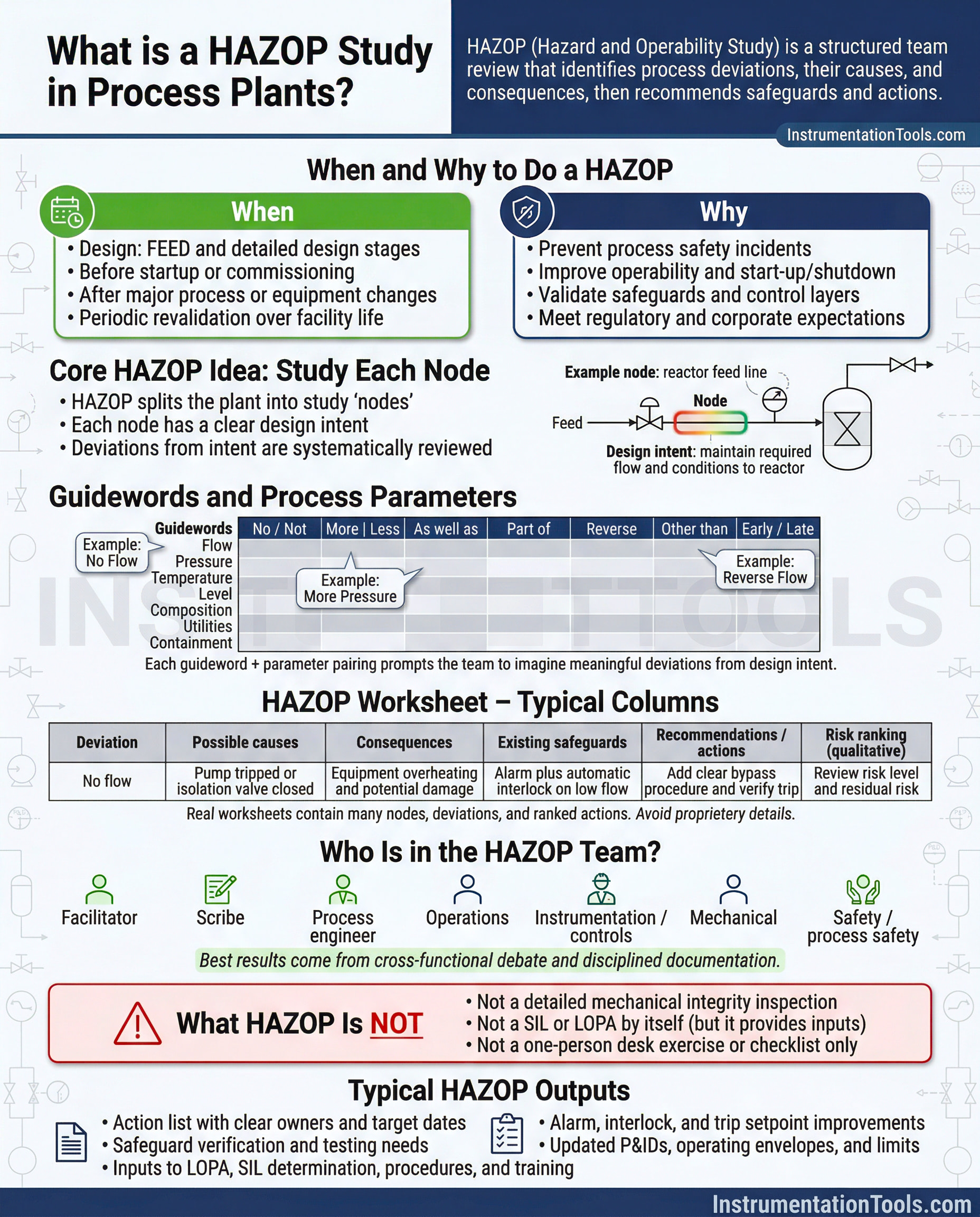
 What is HAZOP?
 Hazard and Operability Study
A structured, systematic risk analysis method
Used to identify deviations, hazards, and operability issues
Simple idea
Compare Design Intent vs Actual Condition
If deviation happens → What is the risk?
 How it works
A team studies the process using guide words:
 No
No
More
Less
Reverse
As well as
Example:
Flow → “No Flow” / “More Flow” / “Reverse Flow”
 What HAZOP identifies
 Possible process deviations
Causes of failure
Consequences (safety, production)
Required safeguards
WATCH VIDEOS:
 Where it is used
 Oil & Gas plants
 Chemical industries
Power plants
Any critical process system
 Who performs HAZOP?
Process engineers
Instrumentation engineers
Operation team
Safety experts
Team-based analysis
 Output of HAZOP
List of risks
Recommendations
Actions to improve safety
 Important
 Not just documentation
 It directly influences SIS design & SIL selection
 Simple understanding
HAZOP = Find problems before they happen
#ProcessSafety #HAZOP #FunctionalSafety #Instrumentation Automation #ControlSystems #Engineering #IndustrialAutomation #SafetyEngineering #OilAndGas