Which instrument is commonly used to test an RTD?
A. Dead Weight Tester
B. Temperature bath
C. Clamp meter
D. Multimeter
View Answer
Answer: B
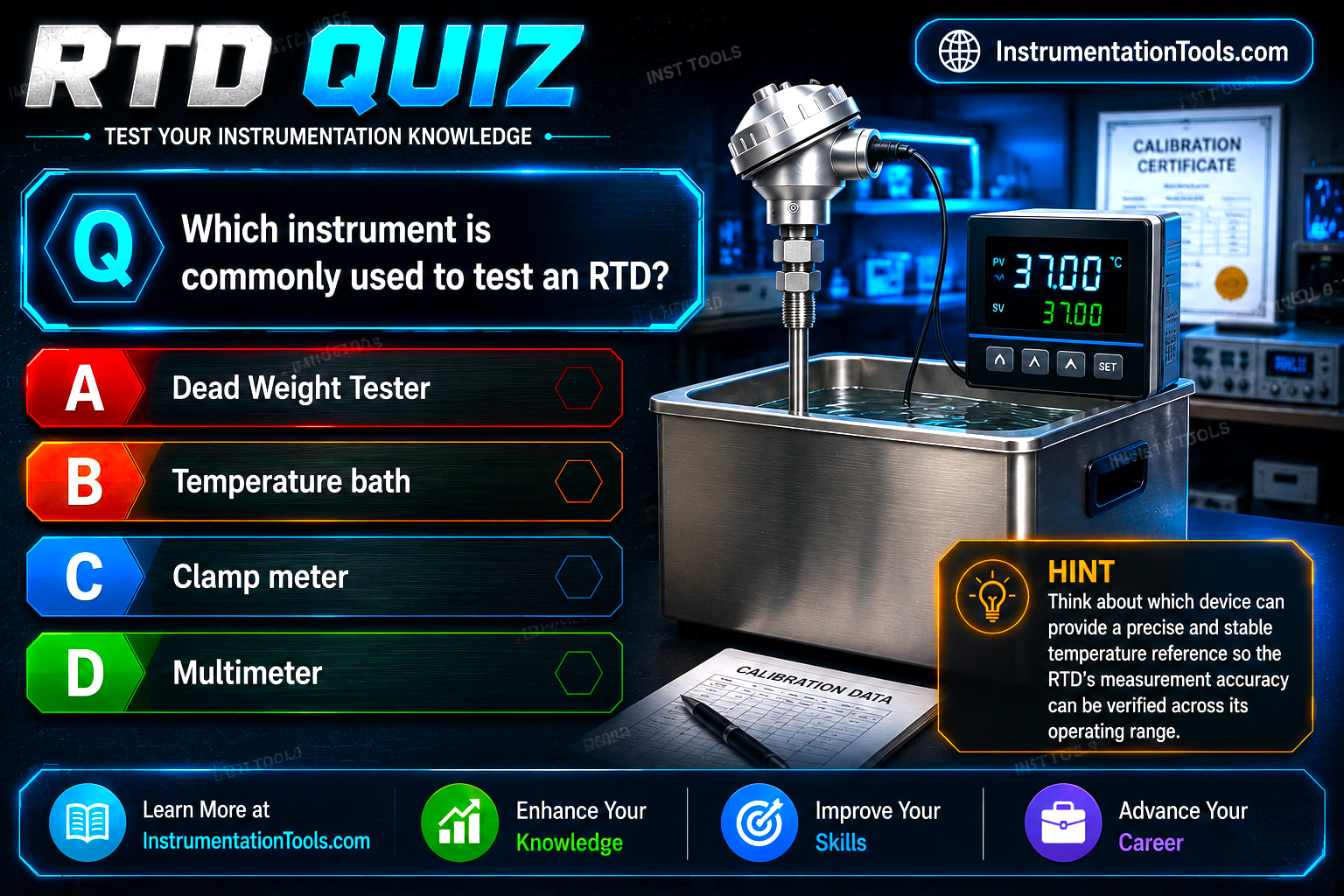
Explanation:
A temperature bath is one of the most commonly used instruments for testing, calibrating, and verifying RTDs in laboratories and industrial calibration facilities.
A temperature bath provides a stable and accurate temperature environment, allowing the RTD to be compared against a reference thermometer or temperature standard.
How RTD Calibration is Performed
- Place the RTD in the temperature bath.
- Set the bath to a known temperature.
- Allow the temperature to stabilize.
- Compare the RTD reading with a calibrated reference.
- Verify accuracy or make adjustments if necessary.
Why the Other Options Are Incorrect
Dead Weight Tester
- Used to calibrate pressure instruments.
- Not used for temperature sensor calibration.
Clamp Meter
- Measures current, voltage, and electrical parameters.
- Cannot accurately calibrate an RTD.
Multimeter
- Can measure RTD resistance and check continuity.
- Useful for troubleshooting, but not typically used as the primary instrument for RTD calibration.
Common RTD Calibration Equipment
 Temperature bath
Dry block calibrator
Precision resistance decade box
Reference thermometer
Temperature calibrator
Because it provides a controlled and known temperature source, the Temperature Bath is the most commonly used instrument for testing and calibrating RTDs.
Therefore, Option B (Temperature Bath) is the correct answer.