Question:
Which parameter mainly influences damping in a PID controller?
Options:
A) Gain
B) Integral
C) Derivative
D) Bias
View Answer
 Correct Answer: C) Derivative
 Detailed Explanation
The Derivative (D) term mainly influences damping in a PID controller.
Derivative action reacts to the rate of change of error:
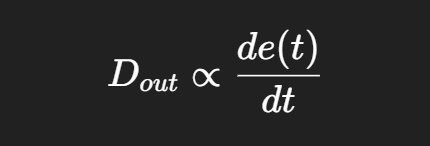
Because it responds to how fast the error is changing, it:
- Opposes rapid movements toward the setpoint
- Reduces overshoot
- Suppresses oscillations
- Improves stability
This damping effect makes the loop smoother and less oscillatory.
 Practical Understanding
If the loop shows:
- Excessive overshoot
- Sustained oscillations
- Underdamped behavior
Increasing derivative time (Td) can improve damping.
 Why Other Options Are Incorrect
A) Gain (Proportional) → Influences speed and sensitivity, not damping primarily.
B) Integral → Removes offset but may increase oscillations if too strong.
D) Bias → Sets baseline output; does not affect damping behavior.