Question:
Which PID term depends on how fast the error is changing?
Options:
A) Proportional
B) Integral
C) Derivative
D) Bias
View Answer
 Correct Answer: C) Derivative
 Detailed Explanation
The Derivative (D) term depends on the rate of change of error — that is, how fast the error is increasing or decreasing.
Mathematically:
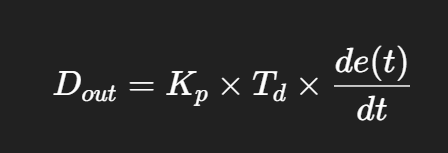
Where:
- ( de(t)/dt ) = rate of change of error
- ( Td ) = derivative time
This means:
- If error changes rapidly → Derivative output is large
- If error changes slowly → Derivative output is small
- If error is constant → Derivative output is zero
Derivative action provides predictive behavior, helping reduce overshoot and improve stability.
 Why Other Options Are Incorrect
A) Proportional → Depends only on present error magnitude.
B) Integral → Depends on accumulated past error.
D) Bias → Is a fixed baseline output, not dependent on error dynamics.
 Simple Memory Aid
- P → Present
- I → Past
- D → Direction (future trend)