Which RTD equation is commonly used for approximate calculations?
A. R=R₀(1+αR)
B. R=R₀(1-αT)
C. R=R₀(1+αT)
D. R=R₀(0.5+αT)
View Answer
Answer: C
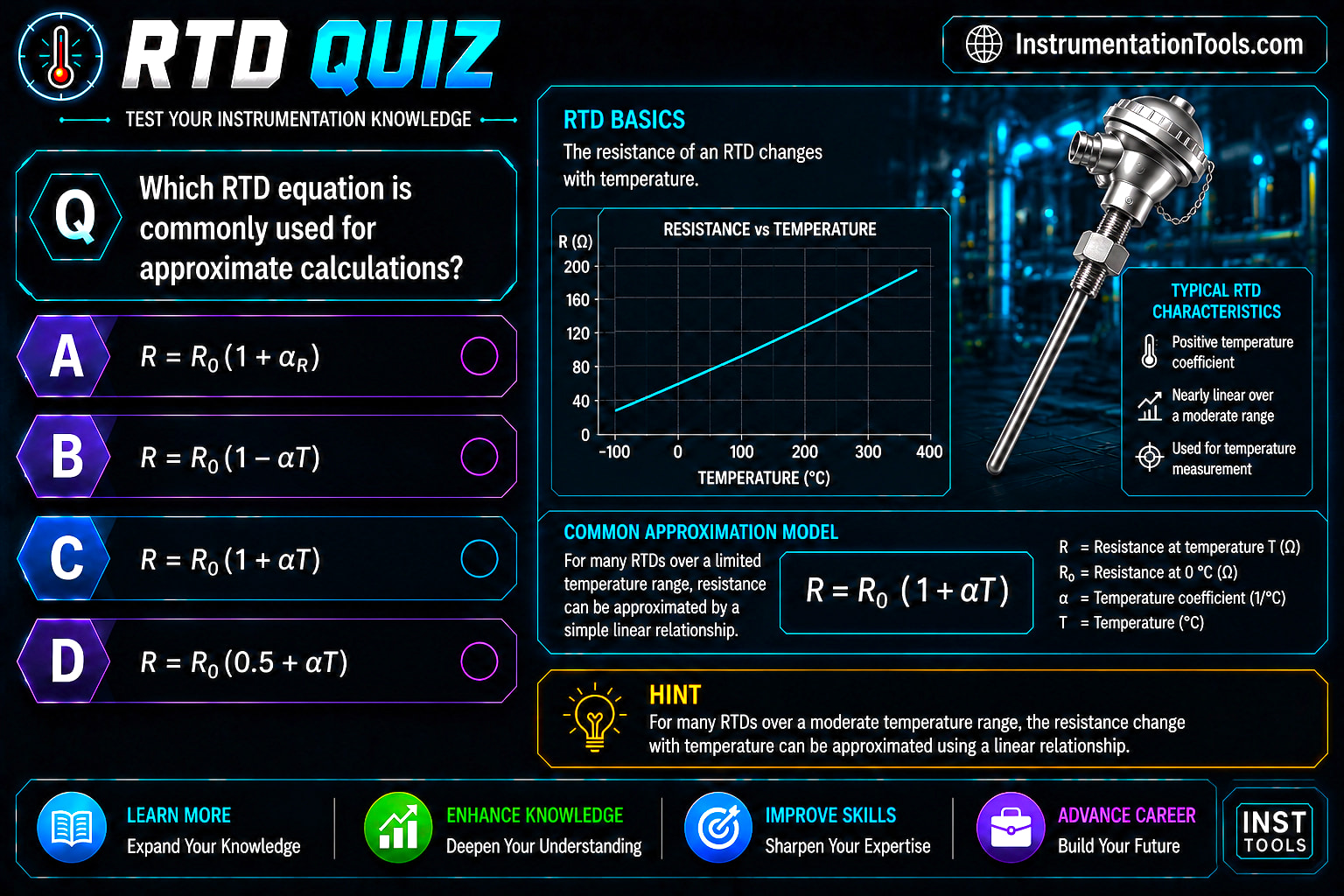
Explanation:
For approximate RTD calculations over a limited temperature range, the following linear equation is commonly used:
Where:
- R = Resistance at temperature T
- R₀ = Resistance at 0°C
- α = Temperature coefficient of the RTD
- T = Temperature in °C
Example for a Pt100
- R₀ = 100 Ω
- α = 0.00385 /°C
- T = 100°C
R = 100(1 + 0.00385 × 100)
R ≈ 138.5 Ω
This equation provides a good approximation for many industrial calculations. For higher accuracy over a wide temperature range, the Callendar-Van Dusen equation is used instead.
Why the Other Options Are Incorrect
R = R₀(1 + αR)
- Incorrect because resistance appears on both sides of the equation.
R = R₀(1 − αT)
- Predicts resistance decreases with increasing temperature, which is opposite to platinum RTD behavior.
R = R₀(0.5 + αT)
- Not a recognized RTD equation.
Therefore, Option C (R = R₀(1 + αT)) is the correct answer. 