Which RTD installation practice improves measurement accuracy?
A. Good immersion depth
B. Reduce sensor immersion
C. Install near pipe elbow
D. Direct process contact
View Answer
Answer: A
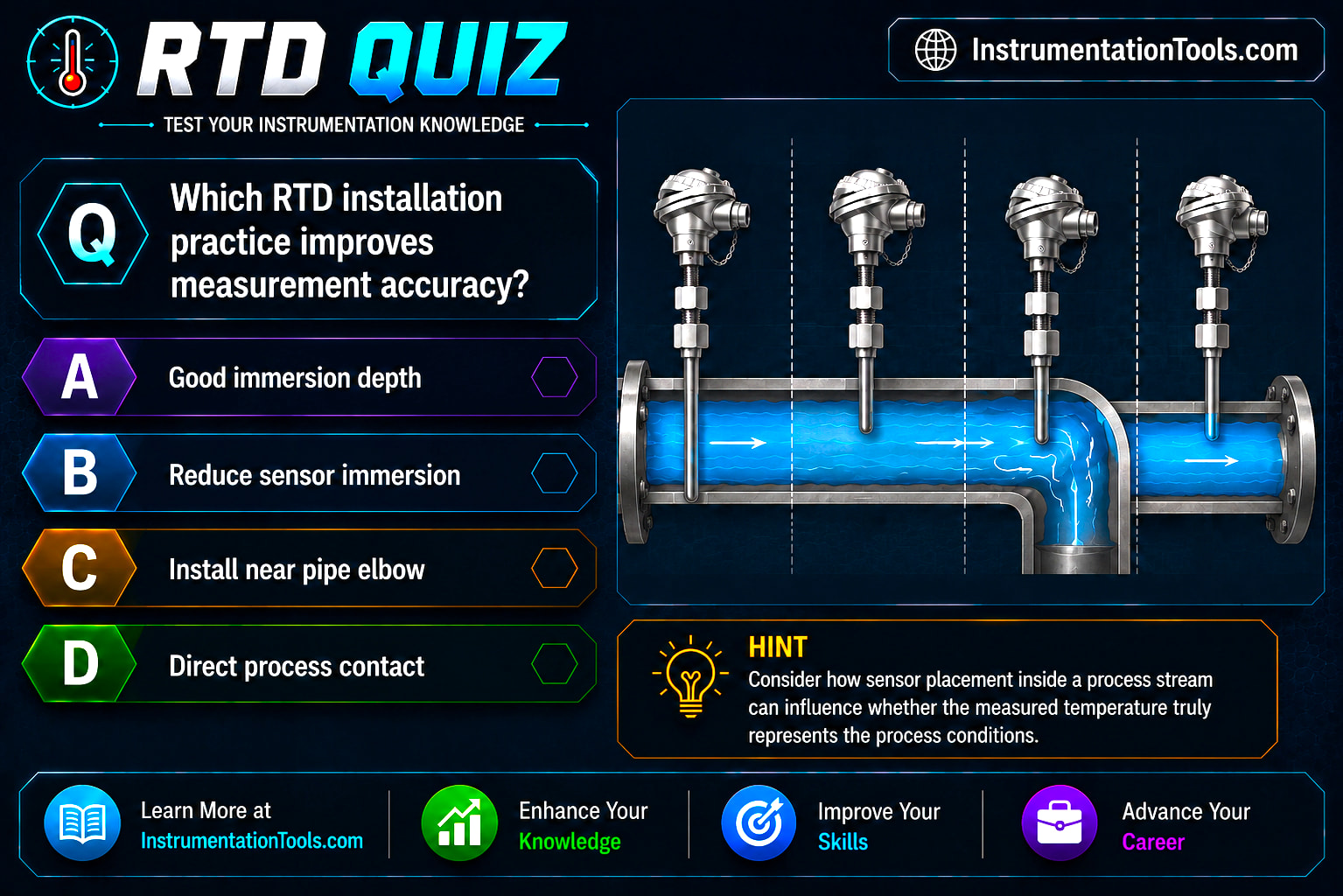
Explanation:
Good immersion depth is one of the most important installation practices for obtaining accurate RTD temperature measurements.
When the RTD is inserted deep enough into the process, the sensing element is fully exposed to the process temperature and less influenced by ambient conditions.
Benefits of Proper Immersion Depth
 Improved measurement accuracy
Reduced stem conduction error
Better heat transfer to the sensor
More representative process temperature
What is Stem Conduction Error?
If the RTD is not inserted deeply enough, heat can travel along the sensor stem to the surrounding air, causing the measured temperature to differ from the actual process temperature.
Why the Other Options Are Incorrect
Reduce sensor immersion
- Increases measurement error.
- Makes the sensor more susceptible to ambient temperature effects.
Install near pipe elbow
- Elbows can create turbulence and non-uniform temperature profiles.
- Generally not preferred unless required by process conditions.
Direct process contact
- RTDs are often installed inside thermowells for protection.
- Direct contact is not always practical or desirable in industrial applications.
Industry Practice
A common guideline is to immerse the RTD at least 10 times the sensor diameter (or as recommended by the manufacturer) to minimize conduction errors and improve accuracy.
Therefore, Option A (Good immersion depth) is the correct answer.