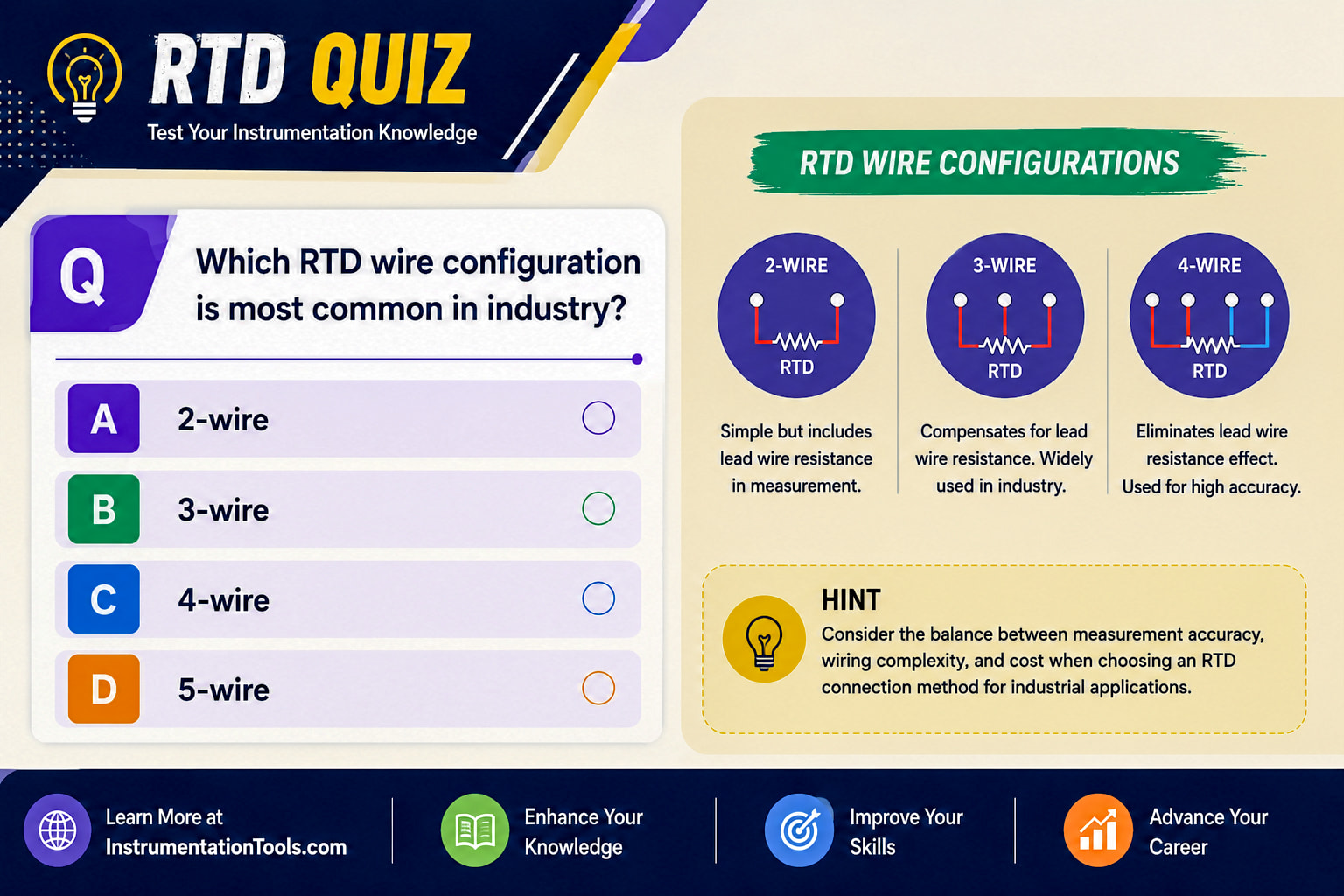
Which RTD wire configuration is most common in industry?
A. 2-wire
B. 3-wire
C. 4-wire
D. 5-wire
View Answer
Answer: B
Explanation:
The 3-wire RTD configuration is the most commonly used RTD wiring method in industrial applications because it provides a good balance between accuracy and cost.
RTD Wiring Comparison
2-wire RTD
- Simplest wiring method
- Lowest installation cost
- Lead wire resistance causes measurement errors
- Suitable for short cable runs
3-wire RTD
- Most widely used in process industries
- Compensates for lead wire resistance
- Good accuracy at reasonable cost
- Commonly used with PLCs, DCSs, and temperature transmitters
4-wire RTD
- Highest accuracy
- Completely eliminates lead wire resistance effects
- Typically used in laboratories and calibration systems
- More expensive due to additional wiring
5-wire RTD
- Not a standard configuration for most RTD applications
A typical 3-wire RTD uses two wires of the same color and one wire of a different color, allowing the transmitter or controller to compensate for lead resistance and improve measurement accuracy.
Therefore, Option B (3-wire) is the correct answer. 